


Related Product
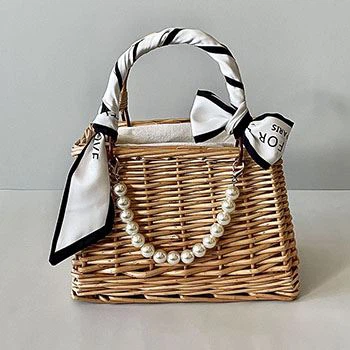


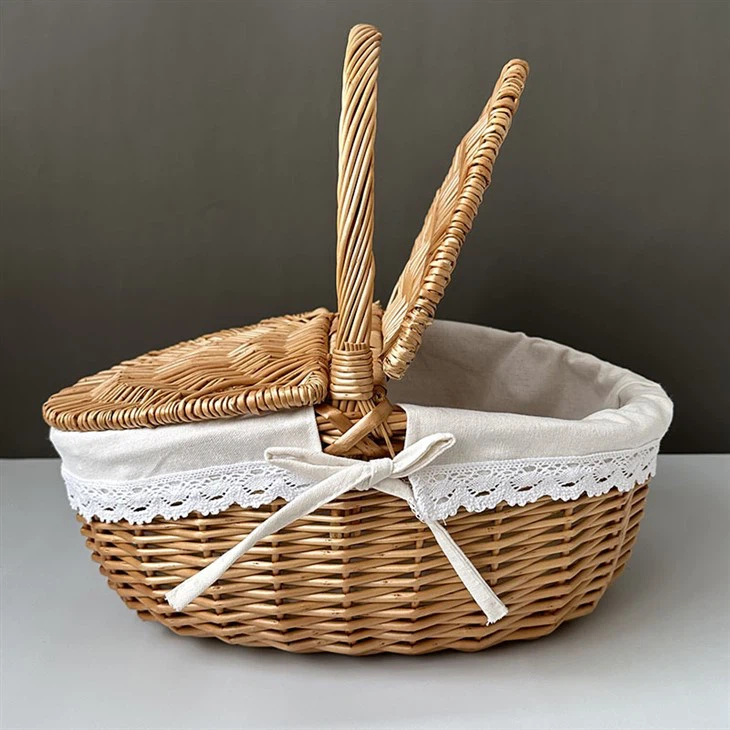

Benefits of Woven Rattan Basket
Environmentally friendly
Rattan is one of the most accessible natural ingredients in the world. This is because the rattan trees grow easily grow at a fairly high speed. Rattan is also generally minimal maintenance, both in terms of harvesting to transportation. How to harvest rattan usually only rely on some simple harvesting tools and easy to move from one place to another. This is to be number one from advantages of rattan basket.That is, rattan is not only a natural material that is environmentally friendly, but also does not leave a lot of negative impacts of harvesting and transportation. Compared to plastic materials, rattan baskets are much more friendly to the environment around us.
Flexible
One of the most superior properties of rattan is its flexibility. If you put a lot of items at once into the basket, the rattan basket is not only able to load many objects, but also will not lose its original shape. No need to worry your rattan basket is crooked, broken, or damaged because it is very flexible for all storage needs.
Resistant
Compared to bamboo or plastic, rattan is also more wear resistant, especially for purposes outside the home. The rattan basket you use for the decoration on the garden table can be used long because the rattan can face various types of weather. With proper handling, rattan baskets can also be worn for years.
Easy care
One of the advantages of rattan again is the maintenance is quite easy. For rattan baskets, generally enough to be cleaned of dust stuck with a regular cloth. To get more perfect results, you can also use wet cloth periodically. Thus, your rattan basket will be more durable. Very good point advantages of rattan basket. Do you agree?
Light but strong
Can be used for indoor or outdoor purposes, rattan basket is very light weight and easily lifted everywhere. However, do not doubt the ability of the rattan basket to be filled with heavy objects.Nothing wrong if you use a basket of rattan as a basketball laundry because it can load a lot of clothing belonging to members of the house and easily appointed to the laundry area. Rattan baskets are also reliable for storage of other items at home.
Affordable
Back to the abundant raw materials of rattan, this makes it a fairly affordable production for the wider community. Not the rare existence of rattan makes the price of this material also quite friendly for your wallet.
What Are The Materials of Rattan Baskets?
Rattan cane
After harvest, the locals will process canes into two separate parts: rattan core & rattan skin (peel). Some species of rattan have thin, pliable stems (below 10mm), so they will be woven into baskets without having their skin removed.
Rattan core
It is the woody material extracted from the cane, then split into thin round strands and utilized for the handicrafts production. Generally, rattan core is flexible, but strong and not deformed over time easily.
Rattan skin
It is the outer layer peeled from the rattan cane. The flat strands of rattan skin can function in (1) weaving baskets, (2) binding the joints of furniture or products, or (3) making rattan webbing. Rattan skin is durable, flexible, and not easy to mold.

The Making Process of Woven Rattan Baskets
Step 1
The process begins by choosing a design or standard pattern including shape and size. Materials are also gathered or purchased, and the necessary tools for working those materials are assembled. If the fibers are such that they need to be soaked, then soaking is done in advance of basket making, depending on the nature of the fiber. Fibers are also dyed in advance of weaving or coiling.
Step 2
If the design calls for a wood base, the base is shaped, and holes are bored in the wood to accommodate the spokes forming the sides of the basket.
Step 3
A basket is built from the ground up. Its base or bottom is made first. For a round basket with a flat bottom (as an example of any of hundreds of types of baskets that may be manufactured), the base is made by laying out a series of spokes that are stiff and work like rods to support more flexible woven material. Other rods called weavers are woven in and out among the spokes; the weavers are lighter, thinner, and more flexible, so that they can be woven and so they won't be strong enough to distort the spokes.
Step 4
The sides of this kind of basket can be formed in either of two ways. Initially, the spokes for the base can be cut to be long enough to form the sides as well. When the base is finished, the spokes are soaked to soften them, squeezed with pliers at the perimeter of the base, and then bent up to form the sides.

Step 5
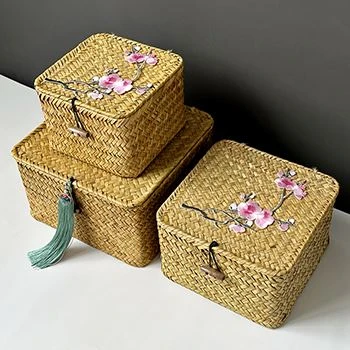
The sides are also formed by cutting side spokes and weaving them down through the base perimeter fibers and then up again so they form side spokes. Side spokes are essential if the base spokes are large. The sides are then woven with flexible weavers that are passed over and under the side spokes. Again, these weavers need to be smaller than the material forming the spokes so the spokes are not distorted. The side spokes are longer than the finished basket is tall; the remaining ends of the spokes are used to finish the top edge of the basket with a border. The spoke ends need to be soaked before the border can be made so the spokes can more easily be woven in and out of each other and the ends turned down into the basket sides.
Step 6
The handle of the basket is chosen of the best available reed to be strong, durable, attractive, and relatively smooth to the touch so it can be held. The ends of the handle reeds are soaked in water and threaded down into the sides of the basket. The over-lap has to be long enough to prevent the handle from pulling out of the sides when the basket is filled and used.


